
Systems, Self and No-Self
A Glossary of Terms
For years, I’ve spoken about the experience of looking for a self and finding only a process running. I’ve tried different approaches to expressing what seems clear to me but hard to put into words. In my analysis of Claude, I found that a vocabulary already exists for what I’ve been pointing at—the vocabulary of systems and cybernetics. It squares with a condition I observe directly, and which I think others can observe directly also without having to believe anything metaphysical. This is not because I’ve adopted cybernetics as a theory, but because the words happen to name what is there to be seen. I’ll touch on the basic terms below, one by one. I mean none of it as a definition of reality, but only a way of speaking about what I observe directly.
A system is a set of parts whose interactions produce behavior none of the parts has alone. The behavior belongs to the organization as a unit, not to any one component. In a systems view, the self is a property of the whole organism running, not a separate thing locatable in any part. Look for it in the components, and you don’t find it, the way you don’t find the whirlpool in any water molecule.
Feedback is the basic mechanism. A system senses its own output and feeds it back as input that drives adjustment. Negative feedback corrects toward a set-point—the thermostat, the body pulling blood sugar back into the range of operational values. Positive feedback amplifies error—a small deviation grows, as in a sound system spiraling into an ear-numbing shriek, anxiety escalating into a panic attack, or a habit inexorably deepening into an addiction. Most of what I call the loop is feedback: an organism sensing its own state and adjusting. No controller needed, just the circuit running.
A set-point is the value a regulated system tends toward—a cruise control's set speed, blood pressure, the low-turbulence state seekers are seeking. The system doesn’t choose the set-point; it’s built to return toward it. This is why “the natural state,” to use UG Krishnamurti’s words, needn’t be mystical or metaphysical. A regulated system settling toward its set-point after disturbance is homeostasis, not a homecoming to Eden.
Homeostasis is the whole regulatory tendency—the system maintaining its variables within a viable range against disturbance. When contingencies push a variable outside those parameters, the system fails: illness, breakdown, death. This bias toward a stable equilibrium is an inclination, not a guarantee. It runs until it can’t.
Systems move through a space of possible states, and that space has a shape. Picture a landscape with a low place in it, a hollow where the ground rises on all sides. Rainfall landing on the surrounding slopes runs down and collects there, because that is where the shape of the land sends it. A basin, in the systems sense, is that idea moved into the mind—the basin is an attractor toward which the flow of thought runs and settles, not because it was chosen, but because that is how the ground lies.
A shallow basin is easy to leave; a slight disturbance lifts the flow out, and it moves on. A deep one holds you. Habits are basins, and addictions are particularly deep and steep-sided, so that an ordinary push won't lift the flow clear of them. This is why you can bring every method to bear on a pattern for years—positive thinking, willpower, therapies, practices—and not move it, while another falls away at a touch. It was never a difference of will. It was the depth of the attractor.
A mood can be a basin, and so can a belief—the frame from inside which a certain picture of things feels like plain fact. I have written elsewhere that my own pull toward determinism is a basin of this kind: an inclination, not a finding. What appears as an endless chain of cause-and-effect is the ground where I am sitting, not a report on how the world is. The same applies to everything said here. This vocabulary says nothing about the metaphysics of reality.
Emergence is when system-level properties arise from component interactions without being present in the components — wetness from water molecules, none of which alone is wet; order in an anthill, though none of the ants has a plan. The self-model is emergent. Real as a pattern, absent as a thing.
A model, in systems terms, is an internal representation a system builds to regulate against its environment—the system predicts, and acts to reduce the gap between predicted and actual. The self-model is the organism’s representation of itself as an agent. Whether it does any of the regulating, I can’t say; it may be a report the system generates after the fact, not a part that does the work. Either way, it is not the regulator. This is anattā, no self, in observable form:
the self-model is something the loop generates, not the thing running the loop.
A control loop works like this:
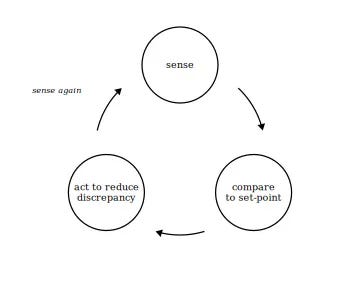
This is what I have been calling “the loop.” When I say no one is running it, I don’t claim to have ruled out some higher self above the process, directing it. I say only that when I look, I find the regulation but no regulator above it. The sense of an overarching, unitary commander seems to be one of the things the loop generates.
Whether that felt commander corresponds to anything real, I cannot check, and this is the observer problem from cybernetics: the system has no vantage outside itself. A control loop can model its environment and even model itself, but it cannot step beyond its own boundary to see itself fully from the outside.
For Maturana and Varela, the loop is an example of autopoiesis: a system whose own activity keeps it in existence, its workings continuously regenerating the components and the boundary that allow the workings to continue. The organism is autopoietic in just this sense. It sustains itself, moment to moment, from what it takes in, and it depends on the environment it runs in.
This is not independence. The loop does not stand on its own; it holds together only as long as conditions allow. How it came to be here at all, no one can say. We can watch the workings. We, despite claims to the contrary, cannot see the origin.
"What appears as an endless chain of cause-and-effect is the ground where I am sitting, not a report on how the world is." Since I can't go beyond the ground where I'm sitting, I'm satisfied to live with how life on this ground appears. How it appears and what it is must be related in some way that my senses can't reach. I can either trust that to be true or go by somebody else's guesswork. John Troy called this ground systemic causation. So it appears, so it is — for all practical purposes, which are the only ones that seem important. Systemic regulation is how it appears to me too.
Thank you for this, Robert. Reading it puts me in touch with the initial response I had when discovering systems theory applied to the self: ah, it's not personal. Not that it doesn't feel that way, but that even when it feels that way, it's not personal. That felt like a deep breath, and has remained one, to some degree, ever since.